Choosing a reliable Power Supply Factory takes more than comparing prices and product photos. The decision affects equipment uptime, safety, repair costs, and customer trust. A polished website cannot show how a factory handles component changes or investigates a failed unit. Ask for evidence you can inspect.
Power-electronics researcher Dr. Robert W. Erickson has published extensively on converter design. In paraphrase of his engineering perspective: “Reliable performance must be demonstrated through sound design and measured testing, not promised in a brochure.” Treat that as a practical reminder, not a verbatim quotation. Request test reports, component traceability, and clear explanations of protection features. Check whether the factory validates products under realistic loads and temperatures. Ask to see how it records failures and corrective actions. Details matter.
Look closely at the production floor, too. Are calibration labels current? Do operators follow consistent assembly steps? Can staff explain what happens when a test result falls outside limits? These questions reveal more than a sales presentation. A supplier may have impressive certificates yet struggle with communication or repeatability. That is easy to overlook.
This guide outlines how to assess engineering capability, quality controls, certifications, production consistency, and after-sales support. It also considers warning signs, sample testing, and questions to ask before placing an order. No checklist removes every risk. A careful factory audit can still miss a weak process or an unreported change. Stay curious, verify claims, and compare evidence before committing.
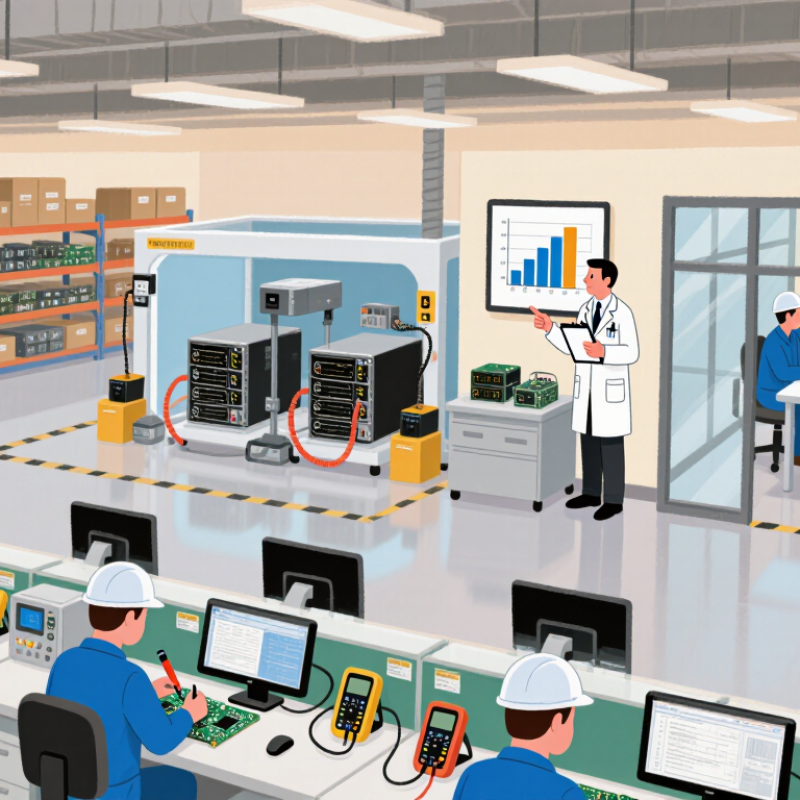
Before contacting a power supply factory, write down the equipment’s actual operating conditions. Specify input voltage, output voltage and current, load changes, operating temperature, and expected daily use.
Include physical limits too: a unit that fits the electrical design may not fit the enclosure. Be precise. Note required protections, such as overcurrent and overtemperature shutdown, and identify relevant safety or performance standards for your target market.
If requirements are still changing, mark them as provisional rather than presenting guesses as final specifications.
Then assess factories against clear criteria. Ask how each unit is tested, whether test records can be traced to production batches, and how design changes are reviewed.
Request sample units and check output stability under realistic loads, not just at idle. Ask about component sourcing, production capacity, lead times, minimum order quantities, and how defects are handled.
A factory’s polished presentation is not proof of consistent process. Look for specific answers and supporting documents.
One detail is easy to miss: a sample may perform well, while later batches vary. Define acceptable tolerances and inspection expectations in writing.
I might still overlook a constraint, so have your engineering team review the specification before approving production.
A reliable power supply factory should show more than a clean showroom and a long equipment list. Check whether its production line matches your product’s voltage, wattage, and expected order volume. Ask to see a working line, not only presentation slides. Look for automated soldering, controlled assembly stations, and clearly labeled inspection areas. Numbers can mislead. Request recent test records and compare them with samples from actual production.
Technical expertise matters when specifications change or a design encounters heat, noise, or load problems. Ask how engineers evaluate efficiency, thermal performance, and protection features. Can they explain their test setup and share measured results? A capable team should discuss trade-offs in plain language, including what it cannot guarantee. Review how design changes are documented and approved. One awkward detail is easy to miss: a strong prototype does not prove consistent mass production. Ask how the factory tracks defects across batches and handles corrective actions.
Tips: Request a sample test report, a production-flow diagram, and a brief technical meeting. Ask who owns each step, from component checks to final testing. If answers stay vague, pause and verify them before placing an order.
A reliable factory can show more than a certificate on its website. Ask for safety documentation that matches the exact model, components, and production site. For information and communication technology equipment, IEC 62368-1 addresses hazards such as electric shock, fire, and excessive temperature. Check the certificate’s scope and issuing body; a quality-management certificate alone does not prove product safety.
Ask how each unit is tested. A sound process may check output voltage, protection against overload and short circuits, and temperature under defined loads. Request test limits, sample records, and procedures for units that fail. Independent reports from an ISO/IEC 17025-accredited laboratory can strengthen the evidence. Details matter. A passing sample is not proof that every production batch performs identically.
Efficiency deserves attention, too. The U.S. Department of Energy’s 2014 external power supply rule projected cumulative energy savings of about 3.7 quadrillion British thermal units over 30 years. That figure reflects a broad market estimate, not a guarantee for any one product. Ask for measured efficiency at several load levels and no-load power consumption. Then compare the results with the claimed specifications. I would also ask to see a recent batch report; paperwork can look tidy while production has changed.
A reliable power-supply factory should show how components move from approved suppliers to finished units. Ask for its approved-vendor records, incoming inspection logs, and lot-level traceability. Check whether substitute components were tested before approval, not merely added to a purchasing list. Resilinc’s 2023 EventWatch report recorded a 38% increase in supply-chain disruptions compared with 2022. That figure does not predict one factory’s performance, but it supports checking backup suppliers and escalation procedures. Some checks are awkward. Ask to trace one recent component lot through inspection, assembly, and shipment.
Capacity claims need evidence from the floor. Compare rated output with recent production records, staffing, equipment uptime, and bottleneck steps such as burn-in testing. Request defect and rework trends, not only a best-month figure. Delivery reliability also needs a clear definition: ask for the past 12 months of on-time, complete shipments and how delays are counted. The World Bank’s 2023 Logistics Performance Index scored Singapore 4.3 out of 5, reflecting national logistics performance, not any individual supplier. Use that context carefully. A neat dashboard can still hide seasonal strain. I would verify figures against sample orders, dated inspection records, and actual production schedules before relying on a promised lead time.
Choosing a reliable power supply factory means comparing more than unit prices. Ask suppliers to quote the same wattage, input range, efficiency target, connectors, and testing scope. A low quote may exclude sample fees, tooling, or required tests. Request itemized pricing and a dated quotation. A single slow reply is not decisive; repeated vague answers are.
Communication matters when technical details change. Send a realistic load profile, operating-temperature range, and forecast volume. Check whether the factory answers clearly and identifies missing information. Uptime Institute’s 2024 Annual Outage Analysis found that 54% of respondents said their most recent significant outage cost over $100,000. That figure does not show that power supplies caused those outages, but it illustrates why clear escalation procedures matter. Confirm warranty length, exclusions, repair or replacement steps, and shipping responsibilities in writing. Ask who handles support and how quickly they respond. A polished sales call is not proof of good after-sales service.
Tips: Request a sample, test report, written warranty, and support contact before ordering. Save the replies and compare their detail. Recheck assumptions after sampling; specifications can shift.
Compare pricing, communication, warranty, and after-sales support
Example evaluation scores on a 1–5 scale, provided as a comparison template rather than measured industry data. Rate each factory using written quotations, response quality, warranty terms, and documented after-sales procedures.
Check whether the line matches your voltage, wattage, and expected order volume. Look for controlled assembly stations and labeled inspection areas.
No. Ask to see a working line, recent test records, and samples from actual production. Numbers can mislead.
Ask engineers to explain efficiency, heat, noise, and load testing. Request measured results and a clear account of what they cannot guarantee.
Not always. Ask how defects are tracked across batches and how corrective actions are recorded. A strong sample can still hide uneven production.
Share wattage, input range, efficiency target, connectors, testing scope, operating temperatures, and forecast volume. Specific details make quotes easier to compare.
Request itemized pricing and a dated quotation. Check whether sample fees, tooling, and required tests are included.
Get the warranty period, exclusions, repair or replacement steps, shipping responsibilities, and support contact in writing. A polished sales call proves little.
Technical changes need clear answers and escalation steps. One slow reply may mean little, but repeated vague responses deserve a closer look. Recheck details after sampling; assumptions can shift.
Choosing a reliable Power Supply Factory starts with clearly defining your electrical specifications, expected order volume, budget, and delivery schedule. Use these requirements to set practical selection criteria, then confirm that the factory has the equipment, engineering knowledge, and production experience needed to meet them. A capable supplier should be able to explain its manufacturing process and show how it manages product quality at each stage.
Also review safety certifications relevant to your needs, inspection methods, and testing procedures. Ask how the factory controls components and suppliers, handles production peaks, and keeps delivery commitments. Finally, compare pricing alongside communication, warranty terms, and after-sales support rather than choosing on cost alone. A careful assessment of these factors can help you select a dependable manufacturing partner and reduce the risk of delays, inconsistent products, or unresolved service issues.

Highfly