Choosing a China-based Enersys Battery Charger supplier requires more than comparing prices. It requires evidence, testing, and careful technical questions.
The International Energy Agency’s Global EV Outlook 2024 reported more than 14 million electric cars were sold worldwide in 2023. That growth increases demand for reliable charging infrastructure, industrial power systems, and replacement support. EnerSys’ fiscal 2024 Form 10-K also reported approximately $3 billion in annual net sales, reflecting the scale of the energy-storage market it serves. These figures do not prove that every supplier is qualified. They only show why selection matters.
David M. Shaffer, former EnerSys President and Chief Executive Officer, stated, “We remain focused on executing our strategy to deliver sustainable, profitable growth.” That principle offers a useful lens when reviewing Chinese suppliers. A dependable partner should provide verified electrical specifications, battery compatibility data, factory quality records, and realistic delivery commitments. Ask for charger efficiency tests, thermal-protection details, alarm functions, and documented after-sales response times. See the evidence.
A strong supplier should explain how its Enersys Battery Charger supports different battery chemistries and operating environments. It should also provide samples before large orders. Factory audits help, but they are not perfect. Reports can look impressive while field performance remains uncertain. This guide compares supplier experience, certification evidence, engineering capability, customization, warranty terms, and total ownership cost. The goal is not simply to find the cheapest charger. It is to identify a supplier that can perform consistently after installation, during peak demand, and when something goes wrong. That last test is often overlooked.
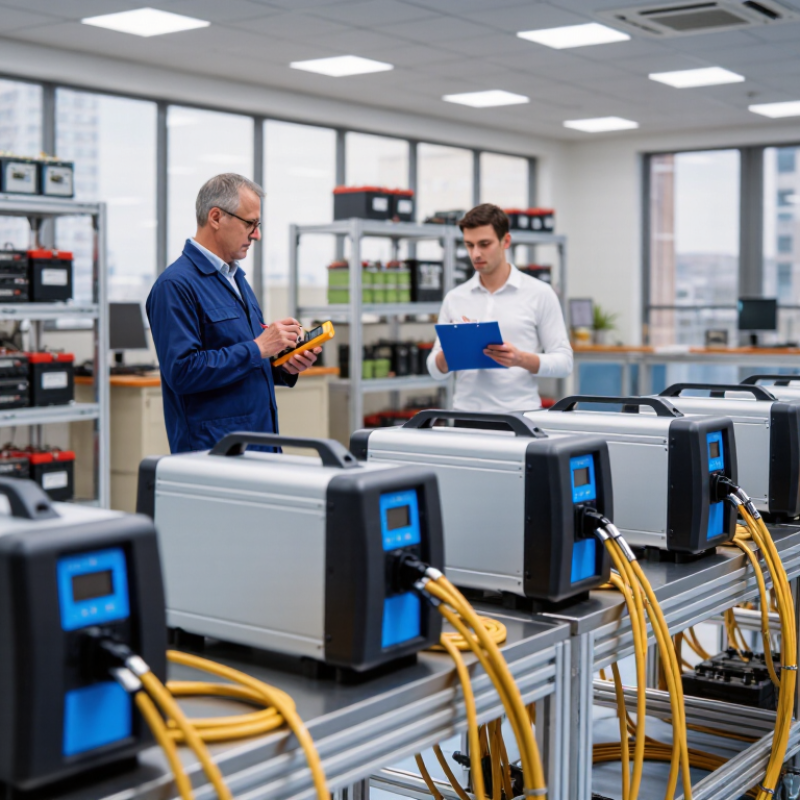
When comparing Chinese battery charger suppliers, begin with the battery system, not the product label. Chargers for 12–96 V systems must match the battery’s actual voltage, capacity, and chemistry. Lead-acid batteries usually need controlled bulk, absorption, and float stages. Lithium batteries require a different charging profile and dependable communication with the battery management system. A 48 V charger is not automatically suitable for every 48 V battery.
Ask suppliers for measured charging curves, output tolerances, thermal limits, and protection settings. Small details matter. Check connector quality, cable length, cooling noise, and enclosure protection for dusty workshops. Lead-acid installations may need temperature compensation and proper ventilation. Lithium systems need accurate cutoffs, fault recovery, and stable performance near full charge. I have found that simple bench tests reveal issues hidden by attractive brochures.
Request sample units and test them under realistic loads. Record voltage, current, temperature, and charging time. Review quality certificates, production traceability, warranty terms, spare-part availability, and technical response times. A reliable supplier should explain limitations clearly, not promise universal compatibility. Paper promises can age badly. One weakness remains easy to miss: a charger may perform well in a clean factory but struggle during summer operation or repeated daily cycles. Allow room for that uncertainty when comparing total value.
| Selection Dimension | 12 V System | 24 V System | 36–48 V System | 72–96 V System |
|---|---|---|---|---|
| Typical battery configuration | Six 2 V lead-acid cells in series, or a 12 V lithium battery pack | Twelve 2 V lead-acid cells in series, or a 24 V lithium battery pack | Eighteen to twenty-four 2 V cells in series, or a matched lithium pack | Thirty-six to forty-eight 2 V cells in series, or a high-voltage lithium pack |
| Common applications | Emergency lighting, small mobility equipment, alarms, access systems and backup power | Small industrial vehicles, floor machines, renewable-energy storage and telecom backup | Material-handling equipment, commercial cleaning machines, utility vehicles and storage systems | Large industrial vehicles, automated equipment, motive-power systems and high-capacity energy storage |
| Lead-acid charging profile | Usually uses a constant-current or bulk stage, constant-voltage absorption stage, and a float stage. Equalization may be required for some flooded batteries but should not be applied unless specified by the battery manufacturer. | |||
| Lithium charging profile | Normally uses constant-current/constant-voltage charging and does not require a continuous float stage. The charger must match the battery chemistry, cell count, charge voltage and battery-management-system requirements. | |||
| Nominal voltage versus charge voltage | Nominal voltage is not the charger output voltage. A 12 V lead-acid battery typically charges at approximately 14.2–14.8 V, while a 12 V-class lithium iron phosphate battery commonly charges near 14.0–14.6 V. Exact values depend on battery chemistry and manufacturer specifications. | |||
| Typical lead-acid bulk/absorption range | Approximately 14.2–14.8 V for a 12 V battery | Approximately 28.4–29.6 V for a 24 V battery | Approximately 42.6–59.2 V, depending on system voltage and battery design | Approximately 85.2–118.4 V, depending on system voltage and battery design |
| Typical lithium iron phosphate charge range | Approximately 14.0–14.6 V for a 4-cell pack | Approximately 28.0–29.2 V for an 8-cell pack | Approximately 42.0–58.4 V for 12–16 cells, subject to pack design | Must be calculated from the cell count and approved maximum charge voltage; generic settings are unsuitable |
| Recommended starting charge-current guideline | For many lead-acid batteries, a starting range of approximately 0.10–0.20C is commonly used. Lithium batteries may accept higher current, but the battery data sheet, BMS limit, temperature range and system wiring determine the permitted value. “C” means charge current divided by rated ampere-hours. | |||
| Charger sizing example | For a 100 Ah battery, a 0.10C guideline equals about 10 A and a 0.20C guideline equals about 20 A. Actual selection must also consider charging time, battery temperature, depth of discharge, charger efficiency and the manufacturer’s maximum current. | |||
| Input power and efficiency | Confirm input voltage, frequency, plug type, power factor and efficiency. The required input power is higher than the DC output power because of conversion losses; allow additional margin for low-line operation and inrush current. | |||
| Battery-management-system compatibility | For lithium batteries, verify BMS charge-enable behavior, low- and high-temperature cutoffs, communication requirements, maximum current, balancing strategy and whether the charger restarts safely after a BMS interruption. | |||
| Essential protection functions | Short-circuit protection, over-current protection, output over-voltage protection, reverse-polarity protection, over-temperature protection and controlled start-up are important baseline functions. Thermal derating should be documented. | |||
| Environmental requirements | Check operating temperature, storage temperature, humidity, vibration, altitude, cooling method and enclosure rating. Chargers installed in dusty or wet locations may require a suitable ingress-protection rating and additional ventilation controls. | |||
| Electrical safety and compliance | Request applicable safety and electromagnetic-compatibility test reports for the destination market. Confirm insulation, grounding, leakage current, creepage and clearance, conducted emissions and radiated emissions requirements. | |||
| Supplier evaluation checklist | Compare datasheet completeness, sample testing, voltage and current accuracy, production consistency, traceability, warranty terms, spare parts, technical support, lead time, customization capability and after-sales response. | |||
| Recommended verification before purchase | Provide the supplier with battery chemistry, nominal voltage, series-cell count, rated capacity, maximum charge current, permitted charge voltage, BMS information, input supply, application environment and required certifications. Test a production-equivalent sample before placing a volume order. | |||
Note: Voltage and current values are general engineering ranges, not universal charging instructions. Always use the battery manufacturer’s approved charging limits and installation requirements.
It should cover components, labor, and response times. Check exclusions for heat, dust, and unstable input power.
A low minimum order quantity supports pilot projects and reduces stored inventory.
Confirm production days, inspection time, shipping arrangements, and spare-part availability.
Include inspections, software updates, fan replacement, technician travel, and emergency support.
Repeated freight charges, slow troubleshooting, and service visits can increase the final cost.
Request audit reports, incoming inspection records, calibration data, and final load-testing results.
Use the intended battery, cable length, and operating temperature. Test voltage stability, efficiency, thermal behavior, alarms, and power recovery.
Specify spare-parts lists, response times, remote diagnosis, technician qualifications, and escalation contacts.
Choosing the right Enersys Battery Charger supplier requires more than comparing prices. First, confirm that the supplier can provide reliable 12–96 V charging systems compatible with both lead-acid and lithium batteries. Product quality should be supported by ISO 9001 manufacturing controls and applicable IEC 60335-2-29, CE, and UL compliance. Key performance indicators include at least 90% efficiency, low output ripple, effective thermal management, and IP54 protection for demanding industrial environments.
A complete cost evaluation should include warranty coverage, minimum order quantity, production lead time, spare parts availability, and expected service expenses over five to ten years. Before placing an order, buyers should conduct factory audits, review technical documentation, test samples under real operating conditions, and assess the supplier’s troubleshooting and after-sales response. This structured process helps businesses select a dependable charger partner while reducing operational risks and long-term ownership costs.

 Highfly